
The True Cost of Downtime: Why Managed IT Is an Investment, Not an Expense
What Does Downtime Actually Cost?
The numbers are staggering — and they add up faster than most business owners realize.
Direct Financial Losses
According to industry research, the average cost of unplanned downtime for a small-to-midsize business ranges from $1,000 to $5,000 per hour. For larger operations, that figure can exceed $300,000 per hour. Even a single hour of email server downtime can cost a 100-person company tens of thousands of dollars in lost productivity alone.
Consider a realistic scenario: your server goes down on a Tuesday morning. It takes three hours to diagnose, another two to fix. That’s five hours of your team unable to access files, communicate with clients, or process orders. At a conservative $2,000/hour, that single incident cost you $10,000 — and that’s before accounting for any data loss.
The Hidden Costs Nobody Talks About
Direct revenue loss is just the tip of the iceberg. The hidden costs of downtime include:
- Employee productivity loss: Your team isn’t just idle — they’re frustrated, demoralized, and often working on tasks they’ll need to redo once systems are restored.
- Customer trust erosion: Every missed deadline, unanswered email, or unavailable service damages client relationships in ways that don’t show up on a balance sheet immediately.
- Data corruption and loss: Improper shutdowns and failed recoveries can corrupt databases, lose transactions, and create compliance headaches.
- Emergency repair premiums: When you need someone right now, you pay rush rates. Emergency IT support can cost 2-3x normal service rates.
- Reputation damage: In the age of online reviews and social media, a single prolonged outage can generate negative publicity that takes months to overcome.
Why Reactive IT Support Fails
Most small and midsize businesses operate on a break-fix model: something breaks, you call someone, they fix it (hopefully), and you move on until the next failure. This approach seems cost-effective on the surface, but it’s actually the most expensive way to manage your technology.
The Break-Fix Trap
Here’s the fundamental problem with reactive IT: you’re always paying for problems instead of preventing them.
When you wait for something to break, you’ve already lost. The downtime has started. Customers are affected. Employees are idle. Revenue is leaking. The “savings” from not having a managed services contract evaporate with a single significant outage.
Break-fix providers also have a perverse incentive: they make more money when things break. A managed IT provider, by contrast, makes more money when things don’t break. This alignment of incentives is fundamental to understanding why the managed services model delivers better outcomes.
The Complexity Problem
Modern business technology isn’t simple anymore. Your environment likely includes cloud services, on-premises servers, remote workstations, mobile devices, SaaS applications, and network infrastructure — all of which need to work together seamlessly.
Managing this complexity reactively is like waiting for your car to break down before changing the oil. Technically possible, but wildly inefficient and expensive.
How Managed IT Turns the Equation Around
A managed IT services provider like MicroSky fundamentally changes the economics of your technology by shifting from reactive to proactive management.
Proactive Monitoring and Maintenance
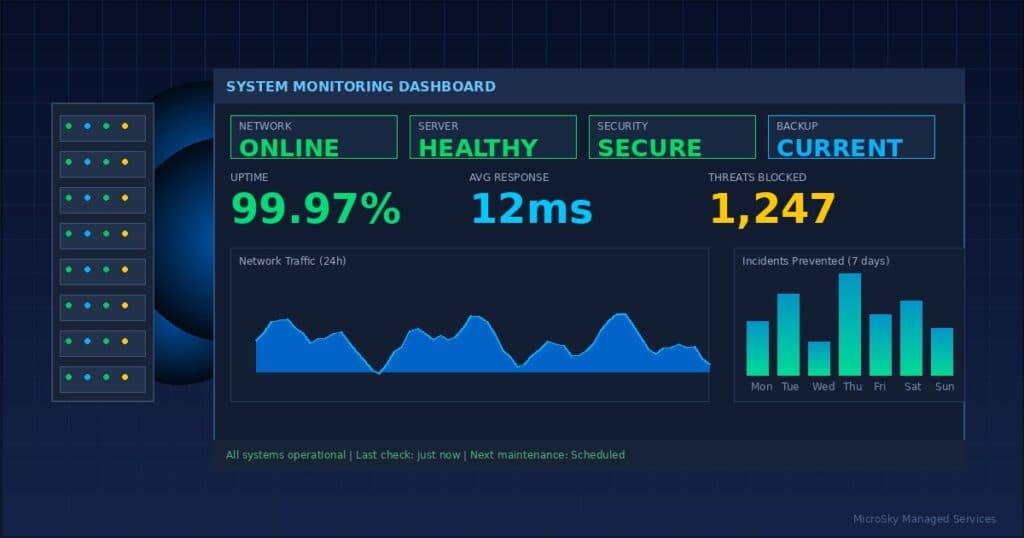
Managed IT isn’t about waiting for the phone to ring — it’s about ensuring the phone never needs to ring. With 24/7 monitoring, automated alerts, and scheduled maintenance, potential issues are identified and resolved before they cause downtime.
This includes:
- Patch management: Keeping all systems updated with the latest security patches and performance improvements
- Hardware health monitoring: Tracking disk health, memory usage, CPU temperatures, and other indicators of impending failure
- Security monitoring: Detecting and blocking threats before they compromise your systems
- Performance optimization: Ensuring your infrastructure runs efficiently and scaling resources as needed
Predictable Budgeting
One of the most underappreciated benefits of managed IT services is budget predictability. Instead of unpredictable emergency repair bills, you pay a fixed monthly fee that covers monitoring, maintenance, support, and strategic planning.
This transforms IT from a variable cost that spikes at the worst possible time into a predictable operational expense you can plan around. For growing businesses, this predictability is invaluable for cash flow management and financial planning.
Strategic Technology Planning
A true managed IT partner doesn’t just keep the lights on — they help you leverage technology for competitive advantage. This includes:
- Technology roadmapping: Planning upgrades and migrations on your timeline, not in crisis mode
- Vendor management: Handling relationships with software vendors, ISPs, and hardware suppliers
- Compliance support: Ensuring your IT practices meet industry regulations and standards
- Scalability planning: Making sure your infrastructure grows with your business
The ROI of Managed IT: A Real-World Perspective
Let’s put this in concrete terms. A typical managed IT services plan for a small business might cost $1,500-$3,000 per month. That’s $18,000-$36,000 per year.
Now consider that a single significant downtime event — one serious server failure, one ransomware attack, one major data loss incident — can easily cost $10,000-$50,000 or more when you factor in lost productivity, emergency repairs, data recovery, and business disruption.
The managed services plan pays for itself by preventing just one serious incident per year. And a good managed IT provider prevents dozens of potential incidents through proactive monitoring and maintenance.
The Compounding Benefit
The ROI of managed IT actually improves over time. As your systems become more stable, as your team becomes more productive, and as your technology aligns more closely with your business goals, the compounding benefits grow:
- Fewer disruptions mean more consistent revenue
- Better security means fewer costly breaches
- Improved efficiency means your team accomplishes more
- Strategic planning means better technology investments
Making the Switch: What to Look for in a Managed IT Partner
Not all managed IT providers are created equal. When evaluating partners, look for:
- Proactive monitoring and maintenance — Not just break-fix with a fancy name
- Transparent reporting — Regular reports on system health, ticket resolution, and recommendations
- Strategic vCIO services — Technology planning aligned with your business goals
- Rapid response times — Guaranteed SLAs for issue resolution
- Security-first approach — Comprehensive cybersecurity integrated into every service
- Scalability — Services that grow and adapt as your business evolves
Conclusion: Stop Paying for Problems
The true cost of downtime isn’t just the hours your systems are down — it’s the cascade of financial, operational, and reputational damage that follows. Every day you operate with reactive IT support, you’re gambling that the next outage won’t be the one that costs you a major client, corrupts critical data, or triggers a compliance violation.
Managed IT services from MicroSky transform your technology from a source of risk and unpredictability into a stable, strategic asset. It’s not an expense — it’s an investment that pays for itself many times over.
Ready to stop paying for problems and start investing in solutions? Contact MicroSky today for a free IT assessment and discover how managed services can protect your bottom line.
Published by MicroSky Managed Services, Inc. | NYC’s trusted partner for managed IT, cybersecurity, and technology consulting.